


BASF produces acid chlorides/chloroformates using renewable electricity credits
German firm BASF’s Intermediates division has advanced its sustainability strategy by converting the entire portfolio of acid chlorides and chloroformates manufactured at its Ludwigshafen site to using 100% renewable electricity credits. Since 2025, the production plant has already been producing its entire portfolio of around 25 products using renewable electricity credits, including all upstream raw material processes.
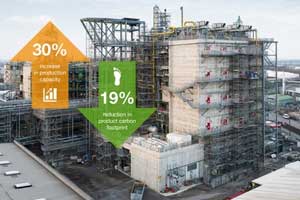
It adds that this transition has already reduced the product carbon footprint (PCF) by an average of 19% in 2025, and similar levels are expected in 2026 and subsequent years. Customers can benefit from a fully seamless transition, with no need for recertification or changes to ordering processes. Products will continue to be supplied as usual but now with a considerably lower carbon footprint, supporting customers in advancing their Scope 3 emission‑reduction efforts.
These sustainability benefits are amplified by the startup of a fully modernised production asset at the Ludwigshafen site. The modernisation project increases BASF’s production capacity for chloroformates and acid chlorides by approximately 30%, meaning that the PCF improvements now apply across a significantly larger product volume while supporting long‑term supply security and meeting growing global demand.
This conversion is said to be another milestone in BASF’s broader ambition to be the preferred chemical company to enable its customers’ green transformation. It follows last year’s global switch of BASF’s amines portfolio to renewable electricity and reflects ongoing efforts to expand the use of renewable electricity and more sustainable practices across BASF’s global intermediates business.2
The German firm says it already offers biobased or biomass balanced (BMB) variants for several acid chlorides and chloroformates. These include biobased products such as palmitoyl chloride, octanoyl chloride and ethyl chloroformate, as well as biomass balanced (BMB) variants for isononanoyl chloride.
With the full portfolio of acid chlorides and chloroformates now produced using renewable electricity credits, it adds that it is taking another meaningful step towards transforming its portfolio, thus providing customers worldwide with additional, seamless opportunities to reduce their carbon footprint without any changes to product specifications or processes.
BASF has an annual capacity of 60,000 tonnes of chloroformates, acid chlorides and alkyl chlorides at production facilities in Ludwigshafen, Germany, and Yeosu, Korea. Customers use these chemicals for further processing in a wide range of applications, ranging from synthesis building blocks for pharmaceuticals and crop protection products to the production of organic peroxides.


