


Indonesia launches 15 solar plants under 100 GWp programme
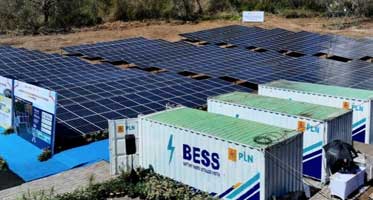 Photo from setkab.go.id
Photo from setkab.go.id
Indonesia is starting work on 15 solar power plants in six provinces as the first projects under a much larger 100 gigawatt-peak (GWp) solar power programme. The initial projects are expected to save the state budget about Rp4.6 trillion (about US$257 million) a year.
The plants will be built in East Java, Central Java, West Java, Bali, the Riau Islands and the Bangka Belitung Islands, according to Government Communications Agency (Bakom) head Muhammad Qodari.
Qodari spoke at a recent press conference, citing that the 15 plants could generate estimated annual savings of Rp4.6 trillion for the state budget.
The government led by President Prabowo Subianto officially launched the 100 GWp programme at a ceremony held in Jembrana, Bali, on August 25. Construction of the first 15 projects began as part of the programme.
Ground-mounted and floating solar plants
The initial projects will include both ground-mounted and floating solar power plants. They are expected to require about Rp135 trillion in investment, with funding coming from domestic and international businesses.
The programme is intended to increase the use of new and renewable energy sources while reducing Indonesia’s reliance on fossil fuels. The government also sees the programme as part of its efforts to meet the country’s climate targets.
Indonesia currently has 1.76 GW of installed solar power capacity, compared with 108 GW of total national electricity generation capacity. Qodari said the country has an estimated 3,294 GW of solar energy potential.
The figures show the large gap between Indonesia’s existing solar capacity and its estimated potential, as well as the scale of the government’s 100 GWp target.
Lower diesel use, renewable electricity for economic activity and wider access
The solar programme is also expected to reduce the amount of diesel fuel used to generate electricity.
Qodari said diesel consumption could fall by as much as 6 million kilolitres a year. The government estimates that the wider programme could save the state up to Rp73.9 trillion annually.
Reducing reliance on fossil fuels is also linked to the government’s concern over fuel imports, which can put pressure on the state budget.
The first 15 plants therefore form only the initial stage of a programme with much larger projected effects on fuel use and government spending.
That said, the electricity generated by the plants will not only be used for general power supply. The programme also plans to direct electricity towards productive activities by micro, small and medium enterprises (MSMEs).
Fishermen are among those expected to use the electricity, including for electric-powered fishing boats.
The programme also aims to supply electricity to areas that previously lacked access to it. As well, the government estimates that the wider 100 GWp programme could create jobs for around 5.52 million workers.