




Evonik launches pilot plant for membrane for green hydrogen
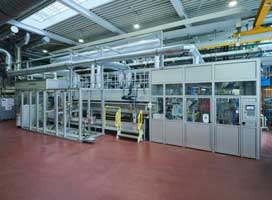
German chemical firm Evonik has begun production of a high-performance membrane at a new pilot plant in Marl, North Rhine-Westphalia. This membrane is a key enabler for the production of more cost-efficient green hydrogen.
Climate-neutral hydrogen is essential for building a more resilient energy system and driving the defossilisation of industry. The pilot plant now manufactures the polymer membrane at a commercial scale, with the capacity to produce membranes for an electrolysis capacity of up to 2.5 gigawatts per year. This represents one quarter of the total electrolysis capacity planned in Germany for 2030.
As part of the energy transition, demand for green hydrogen is expected to grow significantly over the coming decades. In industry, it serves as a sustainable energy carrier and as a feedstock for chemical and steel production.
Green hydrogen is produced via electrolysis, a process that splits water into hydrogen and oxygen using electricity from renewable sources. However, depending on the region, it currently is about two to four times more expensive than gray hydrogen derived from fossil sources. In addition to high energy costs, the electrolysis technology itself also affects the economic viability of green hydrogen production. Established technologies are either limited in efficiency or require high investments.
AEM electrolysis (Anion Exchange Membrane) offers an alternative technology to address these challenges.
Evonik has developed a key component for this process: the anion-conducting Duraion membrane.
“Our membrane delivers high performance while reducing investment costs, enabling the innovative AEM technology to achieve a breakthrough in hydrogen production,” says Christian Däschlein, Head of the New Growth Area AEM in Evonik’s Innovation Factory. Together with experts from the High Performance Polymers business line, his team developed the high-performance membrane specifically for AEM electrolysis.
The commercial adoption of AEM electrolysis technology is accelerating, particularly in Asia and Europe, due to its clear advantages. It operates in an alkaline environment, enabling the use of precious-metal-free and therefore less expensive materials.
Techno-economic studies estimate that this technology could reduce investment costs by at least 25%. In addition, AEM electrolysis can produce hydrogen directly under pressure, eliminating the need for additional, costly compression stages. Its high flexibility also makes it ideally suited for operation with fluctuating electricity from wind and solar power.
The membrane enables AEM technology to reach its full potential by combining high ion conductivity with excellent chemical and mechanical stability. This is crucial not only for its service life but also for the efficiency of the electrolysis process. Another advantage is its reliable separation of hydrogen and oxygen, which prevents the formation of explosive gas mixtures. The membrane is designed for operation at high current densities and pressures. Moreover, no PFAS are added during its production.
The new membrane production facility in Marl is a key milestone for the industrial deployment of AEM electrolysis. With this facility, Evonik says it has successfully transitioned from laboratory-scale development to continuous production.
At nearly 20 m in length, the coating system ranks among the largest of its kind worldwide. It produces membranes up to one meter wide, making it suitable for large-scale electrolysers.
Early manufacturers of AEM electrolyzers are already using the membranes in pilot production and demonstration plants.
The large-scale application of AEM technology is gaining significant momentum, particularly in China. Evonik is strategically addressing this trend: In addition to the production launch in Germany, the new Evonik AEM Center Shanghai has commenced operations in China.
As the company’s first technology-focused application centre in Asia, it is dedicated to AEM electrolysis and its integration into hydrogen infrastructure. At the centre, experts test membranes produced in Marl under real operating conditions in collaboration with local partners and customers


