


Quantum computing being deployed in live energy systems
 Source: Wood Mackenzie
Quantum computing has moved from the lab into live energy infrastructure, and the global race for commercial-scale adoption is accelerating. A new Wood Mackenzie report finds that power grids, LNG networks, and renewables forecasting systems already deploy quantum technology. “The Quantum Disruption of Energy” report says its implications for the energy sector are both immediate and transformational.
In 2024, Google’s Willow quantum chip completed a benchmark computation in under five minutes, a task that would have taken the world’s fastest classical supercomputer 10 septillion years. The energy sectors are already applying that advantage. In 2024, China deployed 85 quantum devices at a 220-kV substation to develop autonomous intelligent substations. E.ON uses hybrid quantum-classical computing for grid management and forecasting for renewables.
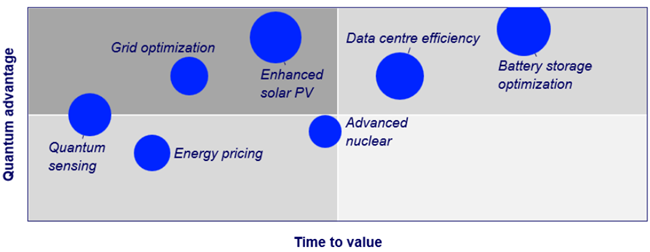
“The quantum energy future is already taking shape,” said Robert Liew, research director, global integrated research at Wood Mackenzie. “Quantum technologies are becoming increasingly relevant to the energy industry, and companies exploring applications such as grid optimisation and quantum sensing are beginning to demonstrate their commercial potential. Over the longer term, these technologies could also unlock significant opportunities in battery storage, solar PV and advanced nuclear.”
Quantum advantage (Comparing marginal benefit of QC vs advanced classical computing)
Source: Wood Mackenzie
The International Energy Agency estimates that global power transmission and distribution losses waste US$130 billion every year. Wood Mackenzie’s research finds that quantum-optimised algorithms can address these inefficiencies at scale, and that near-term applications do not require fully mature quantum hardware to deliver value.
Grid topology optimisation and quantum sensing are the clearest near-term opportunities, with commercial outcomes and an established base of first-mover investors active in these areas. Hybrid computing approaches combining quantum and classical methods are bridging the gap as fully fault-tolerant quantum systems develop.
Beyond grid management, Wood Mackenzie identifies three areas where quantum computing has truly transformational potential:
- Battery storage: Quantum computing can expand the materials search space and dramatically accelerate predictive modelling of molecular behaviour by running simulations in weeks rather than years. The same capability can be applied to R&D in electrolysers, hydrogen, critical minerals, and carbon capture technologies.
- Solar PV: quantum computing can accelerate research into the Singlet Fission process, which has the potential to double solar panel power output.
- Advanced nuclear: quantum simulation could help resolve the tritium fuel supply challenge, model plasma turbulence with high fidelity, and identify new materials capable of withstanding extreme fusion reactor environments.
Despite the potential transformational impact of quantum computing, global power demand for active operational quantum computing systems is limited. However, Wood Mackenzie projects this electricity demand could increase twenty-fold by 2035 in our baseline outlook. In a high-demand scenario where superconducting technology prevails, demand could rise even further. If a technological breakthrough lowers power consumption and increases adoption, total demand could reach even higher requiring over 800 GWh by 2035.
Governments worldwide are moving quickly to establish leadership in quantum. The US is already accelerating quantum computing development and has issued billions in grants to key companies with the government taking minority equity stakes. The EU adopted a Quantum Europe Strategy in 2025 and plans to pass a Quantum Act in 2026. The UK has committed US$3.4 billion over ten years, with dedicated funding for energy-grid applications. China’s 15th Five-Year Plan designates quantum computing as its top economic priority industry for 2026–2030 and. Japan has launched a US$340 million hardware and software programme with 2025 as the first year of quantum industrialization.


